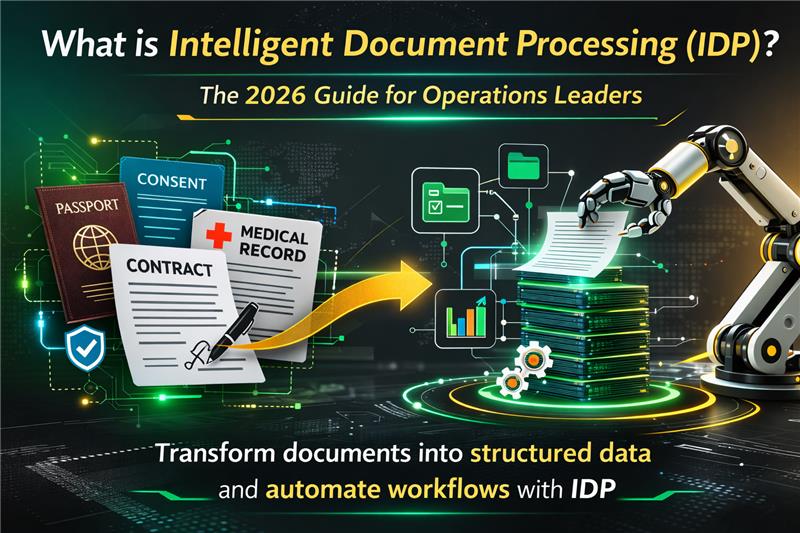
As we navigate the business landscape of 2026, the volume of digital and physical documents—invoices, passports, medical records, and contracts—has reached an all-time high. Yet, surprisingly, many operations leaders still find their highly skilled teams bogged down by the tedious chore of manual data entry.
We are living in an era defined by advanced artificial intelligence, but if your organizational systems only "read" documents without actually "understanding" them, you are leaving massive operational efficiencies on the table.
This is where Intelligent Document Processing (IDP) steps in. IDP is not just a marginal upgrade to old technologies; it is a fundamental shift in how businesses handle unstructured information. In this 2026 guide, we will introduce you to:
- What IDP is and why it matters
- How it overcomes typical process bottlenecks
- How solutions like DocuProx can instantly turn documents into structured data
To understand IDP, we must first look at why legacy Optical Character Recognition (OCR) is no longer sufficient for modern enterprises.
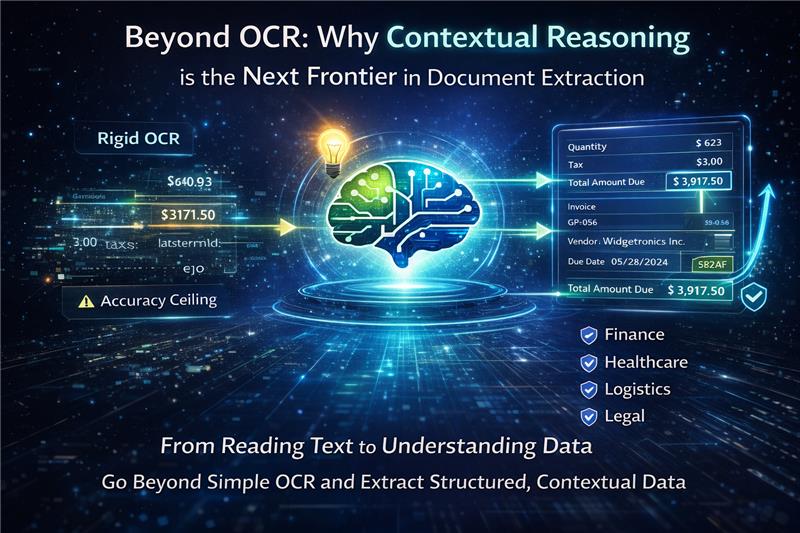
OCR was designed to recognize characters on a page, but it possesses an "Accuracy Ceiling." This ceiling results in:
| Problem | Impact |
|---|---|
| Inconsistent data | Requires manual review |
| Inaccurate outputs | Causes downstream errors |
| Unusable results | Breaks automated workflows |
Furthermore, traditional OCR suffers from what industry experts call "The Missing Brain". Legacy systems "read" but don't "understand," missing critical relationships and insights without contextual reasoning.
Intelligent Document Processing bridges this massive gap. By leveraging advanced Multimodal / Vision Large Language Models (LLMs), IDP solutions apply human-like contextual reasoning to documents. Whether it's a skewed photograph of a receipt, a densely packed bill of lading, or a complex multi-page invoice, IDP looks at the document visually and contextually, extracting exactly what you need with near-perfect accuracy.
If you are an operations leader, you are probably very aware of the friction that unstructured data causes. IDP platforms are designed to address the five fundamental business pain points of document processing:
The Problem: Manual data entry is slow, inaccurate, and a huge resource sink, resulting in substantial financial losses.
The IDP Solution: Enables automatic data extraction, so your employees can concentrate on high-value activities rather than typing away.
The Problem: Inflexible, one-size-fits-all output formats require manual reformatting to conform to applications.
The IDP Solution: Delivers structured and immediately usable JSON that maps directly to your desired database schema.
The Problem: That "efficient" process has a huge hole—automation is a wonderful concept until copy-pasting from PDFs reveals gaps.
The IDP Solution: Seamlessly connects with your core business systems through APIs, removing the need for human intervention altogether.
The Problem: Inaccurate, inconsistent, and useless data from complex formats that require endless manual tweaking.
The IDP Solution: Handles unstructured data complexity effortlessly, including visual irregularities.
The Problem: Systems "read" but don't "understand," missing key relationships and insights without context.
The IDP Solution: Uses Vision LLMs for true contextual understanding of documents.
The best IDP platforms abstract away the underlying complexity of AI, providing a seamless experience for the end-user. DocuProx, presented by Xccelerance Technologies, operates on a simple but powerful methodology:
Define. Connect. Extract.
Here is how an operations team utilizes a modern IDP platform to streamline their workflows:
To begin creating and customizing your templates for document data extraction:
- Log in to the platform at app.docuprox.com
- Visually define your data using bounding boxes
- Or provide inline AI prompts to instruct the system on what to extract
- Save your template and copy its unique identifier
Once your template is defined, connect the platform to your ecosystem:
- Interact with the DocuProx API via direct HTTP requests
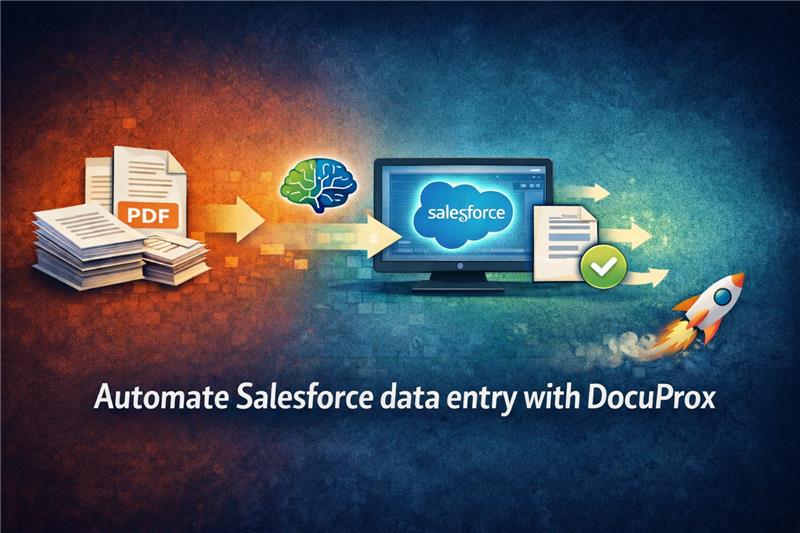
- Or use the methods available in the DocuProx Salesforce Package
- Provide the document file (image, PDF, or base64 format)
- Specify the template ID for processing
The heavy lifting is done in the cloud:
- The API returns a structured JSON response in real-time
- Data is ready to integrate into your workflow immediately
- No more parsing messy text strings—get a clean JSON payload that maps perfectly to your backend systems
Enterprise operations require robust, scalable, and secure infrastructure. A true Intelligent Document API with AI is built to handle millions of documents seamlessly.
Taking DocuProx as a prime example of 2026 architecture:
| Component | Description |
|---|---|
| Cloud Infrastructure | Hosted on secure AWS infrastructure |
| Frontend App | app.docuprox.com for user management |
| API App | api.docuprox.com for high-volume processing |
| Core Engine | State-of-the-art Multimodal / Vision LLM |
| Database | Secure Postgres for metadata, templates, and configurations |
| CRM Integration | Native Salesforce support via dedicated package |
In 2026, security is not an afterthought—it is the foundation of any SaaS platform. When processing sensitive documents like medical records, passports, or financial statements, operations leaders must ensure absolute data privacy.
Modern IDP platforms adhere to a Zero Data Storage Philosophy:
- Documents processed in isolated, encrypted environments
- TLS 1.3 and AES-256 encryption standards
- Documents immediately discarded after JSON data is returned
- AI models do not train on your proprietary data
For advanced workflow automation, webhook integrations are critical:
- Enable webhook access to trigger downstream applications automatically
- Disable webhook access instantly if security policies change
- Active status: Configured with a webhook URL
- Inactive status: Not configured with a webhook URL
This level of granular control, combined with comprehensive audit logs and role-based access control, ensures that your IDP deployment remains secure and compliant.
The strategic imperative for 2026 is clear: manual document processing is a bottleneck that modern enterprises can no longer afford.
Intelligent Document Processing bridges the gap between your chaotic, unstructured documents and your digital systems, transforming static information into dynamic, structured assets.
By adopting an IDP solution that leverages Vision LLMs and outputs clean JSON, operations leaders can:
- Eliminate manual errors
- Drastically reduce processing costs
- Accelerate business outcomes
Ready to transform your document workflows? Visit docuprox.com to get started, or reach out to our team at team@docuprox.com.