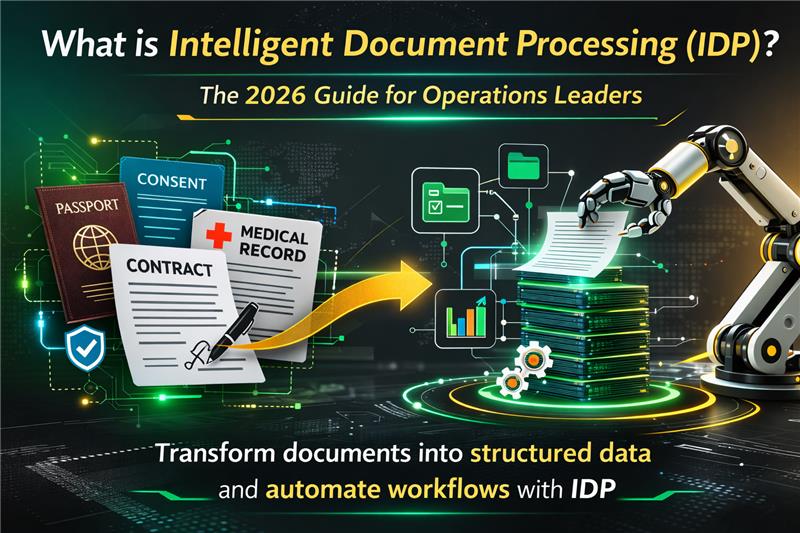
We live in an era overflowing with data, but for too many organizations, their most valuable information remains trapped on a page. If your business struggles with documents processing and unstructured information, you are certainly not alone. For decades, companies have relied on Optical Character Recognition (OCR) to digitize their paper trails. While OCR was revolutionary in its time, it is no longer sufficient for the complex, high-stakes data needs of modern enterprises.
The future is clear: organizations must be able to turn their documents into structured data instantly. Making this leap requires a fundamental shift from simply "reading" characters to genuinely "understanding" context. Let's dive into why contextual reasoning is the next frontier in automation and how cutting-edge technologies like Multimodal Vision LLMs are leading the charge.
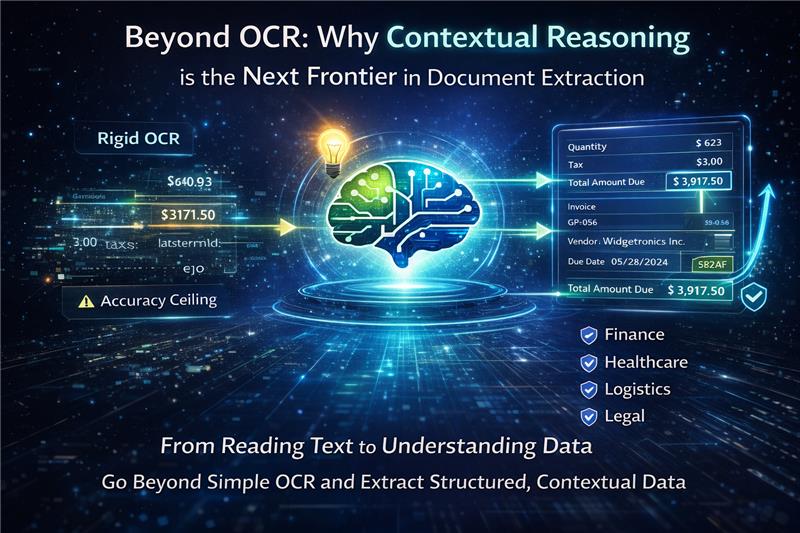
OCR technology operates on a simple premise: pattern recognition. It scans a digital image, identifies shapes that vaguely look like letters or numbers, and converts them into text.
However, this rigid approach has severe limitations when faced with the real-world complexity of modern business documents. The cracks in the system usually appear in the following ways:
OCR suffers from a fundamental lack of understanding; these systems can "read" text but they do not "understand" it. Without contextual reasoning, OCR misses critical relationships and insights hidden within the document.
Relying on legacy OCR often results in inconsistent, inaccurate, and unusable data, especially when dealing with complex formats. This inherent inaccuracy necessitates endless manual correction.
Many companies implement OCR-based automation that looks great on paper, but reveals major gaps when users are forced into copy-pasting from PDFs to fix errors.
When automated workflows fail, humans must intervene to fix the mess. Manual data processing is slow, error-ridden, and represents a constant drain on resources, ultimately leading to significant financial loss.
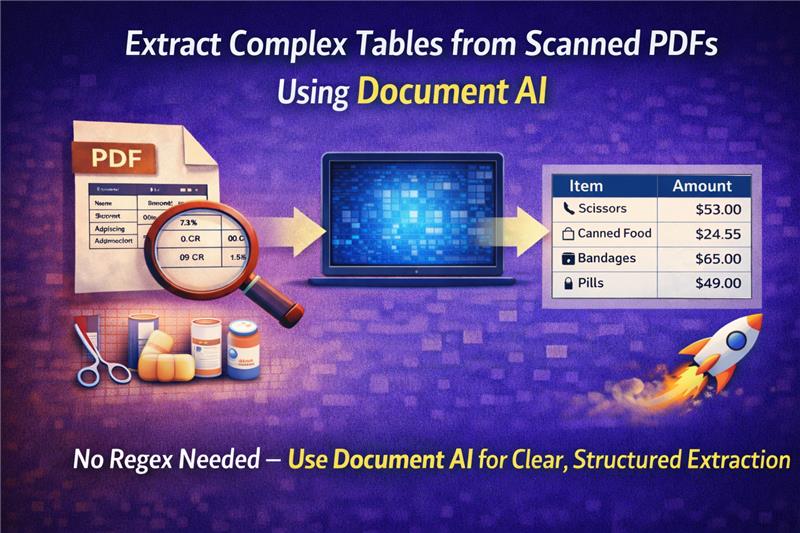
Even when traditional OCR correctly identifies the text on a page, it rarely delivers that data in a format that modern applications can seamlessly consume. This creates a massive data transformation puzzle.
Traditional systems often provide rigid, one-size-fits-all outputs. Because the extracted data is unstructured or poorly formatted, developers and data entry teams are forced to manually structure it to fit their specific applications. What businesses actually need is ready-to-use, structured JSON.
This massive gap between a raw "text dump" and structured, actionable data is exactly where contextual reasoning becomes essential.
Contextual reasoning represents a paradigm shift in artificial intelligence. Instead of just identifying individual characters line by line, advanced AI models—specifically Multimodal/Vision Large Language Models (LLMs)—analyze the entire document holistically, much like a human would.
Visual Understanding: Vision LLMs evaluate the physical layout of the page. They understand that a bold, centered string of text at the top is likely a title, while text aligned closely next to a checkbox represents a form field.
Semantic Analysis: These models understand language and intent. They know that "Total Amount Due," "Final Balance," and "Please Pay" all refer to the exact same conceptual data point, regardless of the specific phrasing chosen by different vendors.
Relationship Mapping: Contextual reasoning allows the AI to map out related pieces of information. It understands that a line item in a complex invoice table is directly related to the column headers above it, and contributes to the subtotal below it.
By applying this level of reasoning, an AI doesn't just extract text; it extracts meaning. It ends the guesswork, guaranteeing structured data that you can actually rely on.
To understand why this solution is so effective, it helps to look at the team behind it. Presented by Xccelerance Technologies, DocuProx is the result of years of solving complex enterprise data challenges.
We combine deep technical knowledge with cutting-edge AI capabilities to deliver transformative digital solutions that drive real business outcomes.
- Our team of expert developers, consultants, and strategists work together to turn complex challenges into streamlined solutions.
- Our core strengths are deeply rooted in Digital Strategy and AI Innovation.
- We believe in building lasting partnerships, not just delivering projects.
- From initial strategy to ongoing optimization, we ensure your technology investments deliver measurable returns.
- Our success is measured by your achievements, and we're committed to supporting your journey every step of the way.
We realized that the industry didn't just need a slightly faster OCR tool; it needed a complete overhaul. So, we built an intelligent document API powered by AI that bridges the gap between chaotic documents and structured digital systems.
The power of contextual reasoning requires robust, scalable infrastructure. The DocuProx architecture is designed for immense scale and absolute ease of use:
- Cloud Infrastructure: The entire system operates smoothly and securely, utilizing AWS.
- The Frontend Interface: Users easily manage their workflows via the frontend app hosted at app.docuprox.com.
- Robust Data Storage: We utilize Postgres to reliably store and manage data.
- The Core Processing Engine: The heavy lifting is executed by the API app hosted at api.docuprox.com.
- Advanced AI Engine: The API communicates directly with an advanced Multimodal/Vision LLM.
- Seamless Integration: When a user triggers some action, your code communicates seamlessly. For specialized environments, we even offer a dedicated DocuProx Package to streamline integration directly within Salesforce.
Leveraging this technology is remarkably simple. Here is how DocuProx transforms your workflow:
The process begins with template configuration, where you log in to the platform (app.docuprox.com) to begin creating and customizing your templates for document data extraction. Our platform lets you specify exactly what data to extract, from simple fields to complex nested tables using visual annotation and inline AI prompts. After saving a new template, make sure to copy and store its unique identifier.
Next, you integrate with the API. You can interact with the DocuProx API (api.docuprox.com) either by making direct HTTP requests or by using the methods available in our DocuProx Salesforce Package.
To initiate the extraction, your request will need to provide the document file (as an image or PDF, or in base64 format) and specify the template ID for processing. The API will return a structured JSON response in real-time, containing the extracted data for you to integrate into your workflow.
When you deploy a system capable of true understanding, the applications across your organization are limitless:
Financial Services: Automate invoice processing and complex tax documents where data fields constantly shift.
Healthcare: Process patient intake forms and medical records, ensuring critical health data maps correctly to EHR systems.
Logistics & Supply Chain: Instantly extract line-item details from highly variable bills of lading and vendor invoices without writing custom parsing rules.
Legal & Compliance: Analyze dense contracts to extract key clauses, dates, and party information with precision.
We are finally stepping out of the dark ages of automated guesswork. The era of rigid, template-bound OCR is coming to an end, replaced by intelligent systems that adapt, reason, and understand. By making the leap to contextual reasoning and Multimodal Vision LLMs, your organization can finally turn your documents into structured data, instantly.
DocuProx provides the complete toolkit to define, connect, and extract the vital information your business needs to thrive. Stop scanning, and start understanding.
Have questions about getting started with DocuProx? Feel free to reach out to our team at team@docuprox.com or join our community discussions.